After Embolisation FAQ
How long would I stay in hospital?The normal hospital stay is 1 night.
How long does it take to recover?Recovery varies - one woman went to a party the day after leaving hospital, buy but normally women return to work in 1-5 weeks.
What care will I need?Again this varies a lot, but some women get flu-like symptoms and will need some care at home for a few weeks.
What will I be able to do afterwards?Unlike surgery there is no restriction to movement, driving, lifting etc. A normal sex life can be resumed and there are no adverse effects on the enjoyment of and desire for sex. Pleasure may be enhanced as general health and heavy bleeding etc will have improved.
Side effects and safetySome women (5-7%) can develop a high temperature approximately 10 days after embolisation. This is part of the fibroids breaking down, but needs to be differentiated between infection and the post-embolisation syndrome. If this happens the radiologist or GP should be called. Abnormal periods and bleeding may occur for a few months, although this varies widely. There is a vaginal discharge for a few weeks, although this can go on for longer in a few cases. In 2.8 - 7% of women fibroids can be expelled - delivered through the vagina. This sometimes requires assistance from the radiologist or gynaecologist. It is not a painful process and the women may be pleased to be rid of it/them. This can happen up to 2 years after the procedure. A few women (1%) get an infection, which needs to be treated with antibiotics. Embolisation is much safer than hysterectomy with lower mortality rates and serious adverse side effects. Success Rate
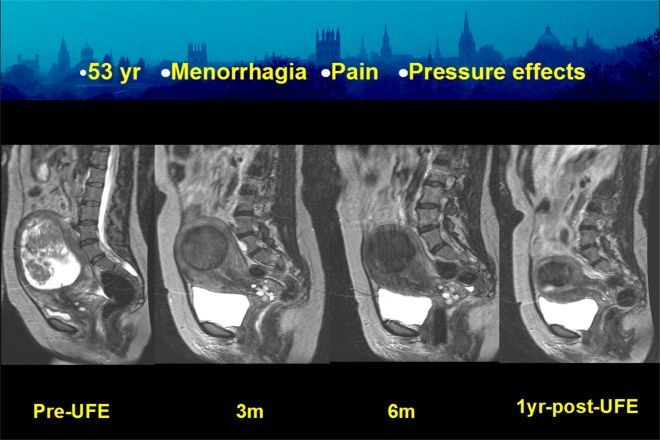
The vast majority of women are relieved of their symptoms of heavy and painful periods (85%) and pressure symptoms (78%). Patients are very satisfied with the treatment and the vast majority would have it again. Click on the image for a larger version of MRI scans showing fibroids pre and post the embolisation procedure.
Long term side effectsApart from a serious infection there are few long-term side effects from embolisation. In some (0.25-7%) there is an infection or the reduction in fibroid size can be insufficient and they will go on to have a hysterectomy. Some women develop a persistent discharge. This usually resolves spontaneously or with hysteroscopy.
Effect on fertilityWomen will maintain fertility and some go on to have successful pregnancies if they desire. There have been at least 50 successful pregnancies so far. A small percentage of women develop amenorrhoea (periods stop). This usually resolves, but persists in 1-7%.
What can go wrong?Any procedure can result in infection or DVT (deep vein thrombosis - a potentially dangerous blood clot usually in the leg). Both are much less likely to occur with embolisation than surgery. Questions to ask your doctor
|

You are here:
Home Treatment Options Embolisation Afterwards
Our Survey and Guidelines
NICE Review of their Clinical Guidlines on Heavy Menstrual Bleeding carried out by part of RCOG is launched 14th March'18. FEmISA condemns it as unsafe for women - see our press release. FEmISA queries NICE's figures on hysteroscopy. This is regressive - see our concerns and our submission to this NICE eEview.
See FEmISA's new report on NICE compliance and patient choice for fibroid treatments part of this report was included in the recent APPG On Women's Health report Informed Choice? Giving women control of their healthcare
Thanks to all who took part in our survey about the information and choices for their fibroid treatment. Please click here for the Patient Information and Choice Survey report and here for our report on access to UFE treatment with The Medical Technology Group and All Party Parliamentary Group on Improving Patient Access to Medical Technologies.